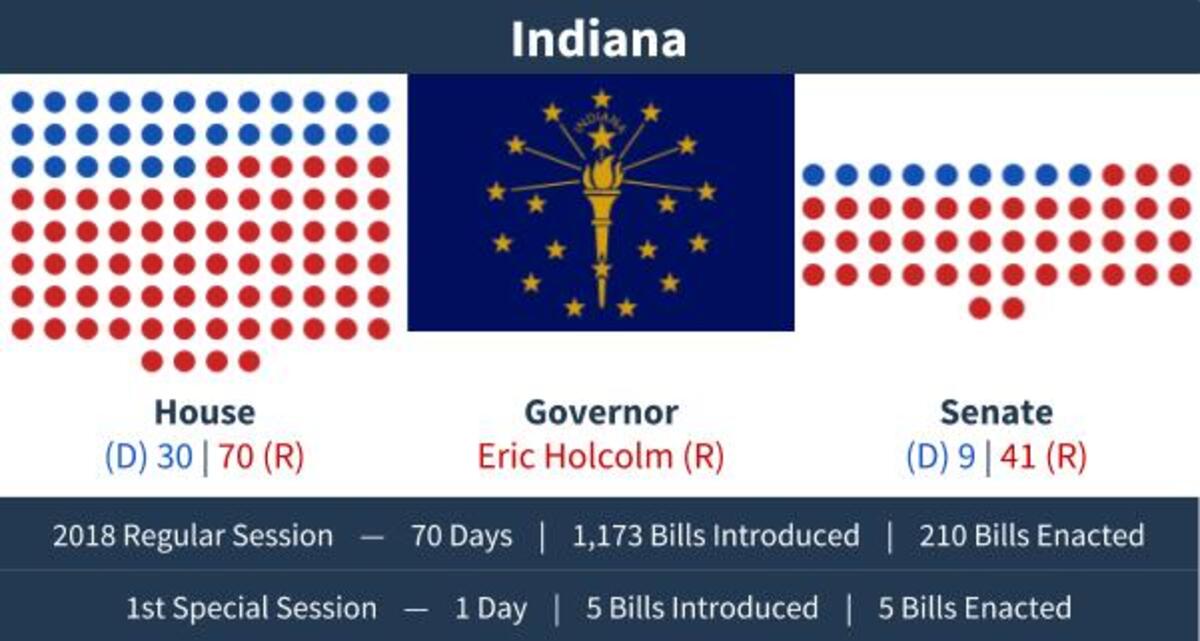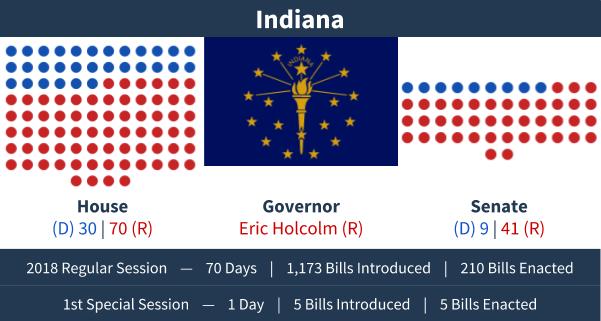
Indiana adjourned its 2018 legislative session sine die on March 14, and Governor Eric Holcolmb (R) finished acting on the bills sent to his desk on March 21. As the session came to a close, party infighting consumed the legislature, leading to a political stalemate among Republicans. As the night wound down, lawmakers were unable to agree on a number of key bills regarding taxes, guns, technology, and education. After the dust settled, Governor Holcolmb announced his plan to call a special session to be held on May 14.
During the one-day special session, legislators adopted five bills left unfinished in the regular session, including a measure adjusting the tax code in response to the federal tax reform. Lawmakers legislation also approved additional funding for school safety measures.
Legislative Highlights
- The governor signed two bills related to workforce development. One bill (HB 1002) doubles the size of a grant program created to help employers pay the costs of training their workforce, while a second bill (SB 50) establishes the governor’s workforce cabinet charged with supervising how the state’s workforce funds are spent.
- Lawmakers agreed, with an overwhelming majority, to pass legislation requiring the state to transfer money from the state tuition reserve account to the state general fund if public school enrollment is larger than expected. Indiana suffered a $11.8 million shortfall in funding for public school systems last year.
- Indianans will now be able to purchase carryout alcohol on Sundays between noon and 8 p.m., putting an end to a decades-long legislative fight. Hoosiers can legally purchase alcohol on Sundays at liquor stores, convenience stores, and big box retailers.
Election Preview
Indiana voters will go to the voting booths on November 6 to vote for all 100 seats in the House and 25 of the 50 seats in the Senate. On November 6, Indianans will also vote on a legislatively-referred constitutional amendment that would require the legislature to enact a balanced budget for each budget period. The governor will not face the voters until 2020.