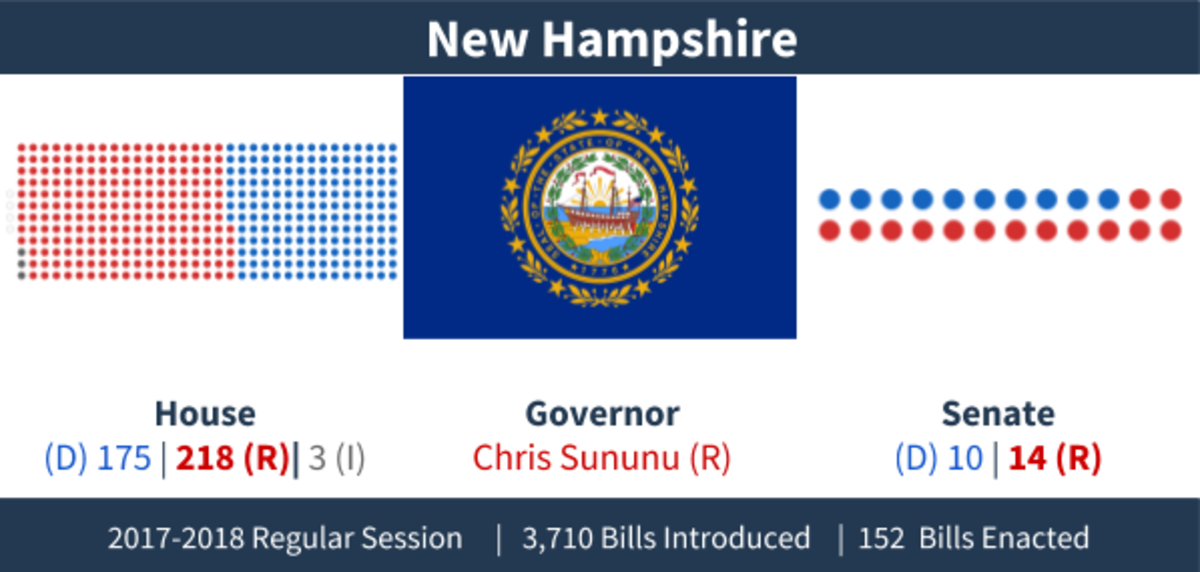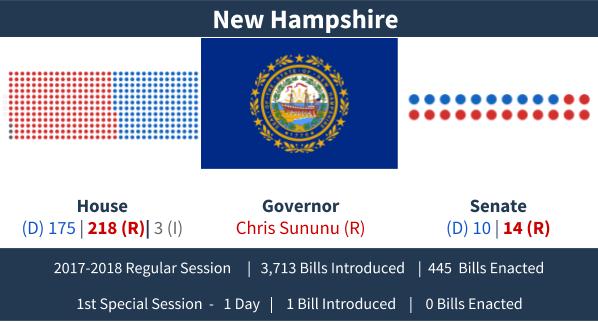
New Hampshire adjourned its 2018 legislative session on May 23, and Governor Chris Sununu (R) finished acting on bills sent to his desk in mid-July. The session was marked by a surprise windfall comprised of unexpected tax revenue, excess federal funds, and deferred revenue freed up from an audit, in all totaling over $150 million. The legislature quickly set about earmarking the extra money of which $44.6 million went to ending a dispute between New Hampshire hospitals related to uncompensated care payments.
Additionally, the legislature held a one-day special session on July 25 to discuss the impact of a recent U.S. Supreme Court case, South Dakota v. Wayfair (June 21, 2018), involving internet sales taxes. Though a bill (NH SB 1 A) to protect New Hampshire businesses initially garnered enthusiasm, the legislation died in a back-and-forth between chambers. In advocating for the creation of a “study group,” the House gutted the initial bill text that had been passed unanimously by the Senate. In return, the new House version was promptly voted down by the Senate as the session came to a close. The Legislature is scheduled to return for a veto session on September 13.
Legislative Highlights
- In spirit of the state’s overflowing coffers, a bill (HB 1817) to fund a state demographer quickly evolved into the session’s primary omnibus spending bill as legislators began tacking on multi-million dollar appropriations to repair red-listed bridges ($20 million for FY 2018, and an additional $10.4 million in FY 2019 for “state bridge aid”), fund the Governor’s Community Development Finance Authority ($1,000,000 in FY 2018), and place $10 millinion into a rainy day fund.
- Though the omnibus spending bill stole the limelight, the legislature also passed a $11.7 billion state budget for FY 2018-2019.
- Governor Sununu vetoed a bill (SB 593) abolishing the death penalty. While this bill’s veto restrains reform on one end of the criminal justice spectrum, New Hampshire passed another bill (SB 556) which would circumvent bail in favor of release upon “personal recognizance.”
Election Preview
New Hampshire voters will go to the voting booths on September 11, 2018, for the state primaries, and November 6, 2018, for the general election. Governor Sununu is running for a second two-year term this year. As of now, the state “leans Republican,” and any gubernatorial candidate will be facing a popular incumbent in Governor Sununu. Voters will also decide all 24 seats in the Senate and all 400 seats in the House.